Who AI cites when patients ask about plastic surgery.
 By Garth House
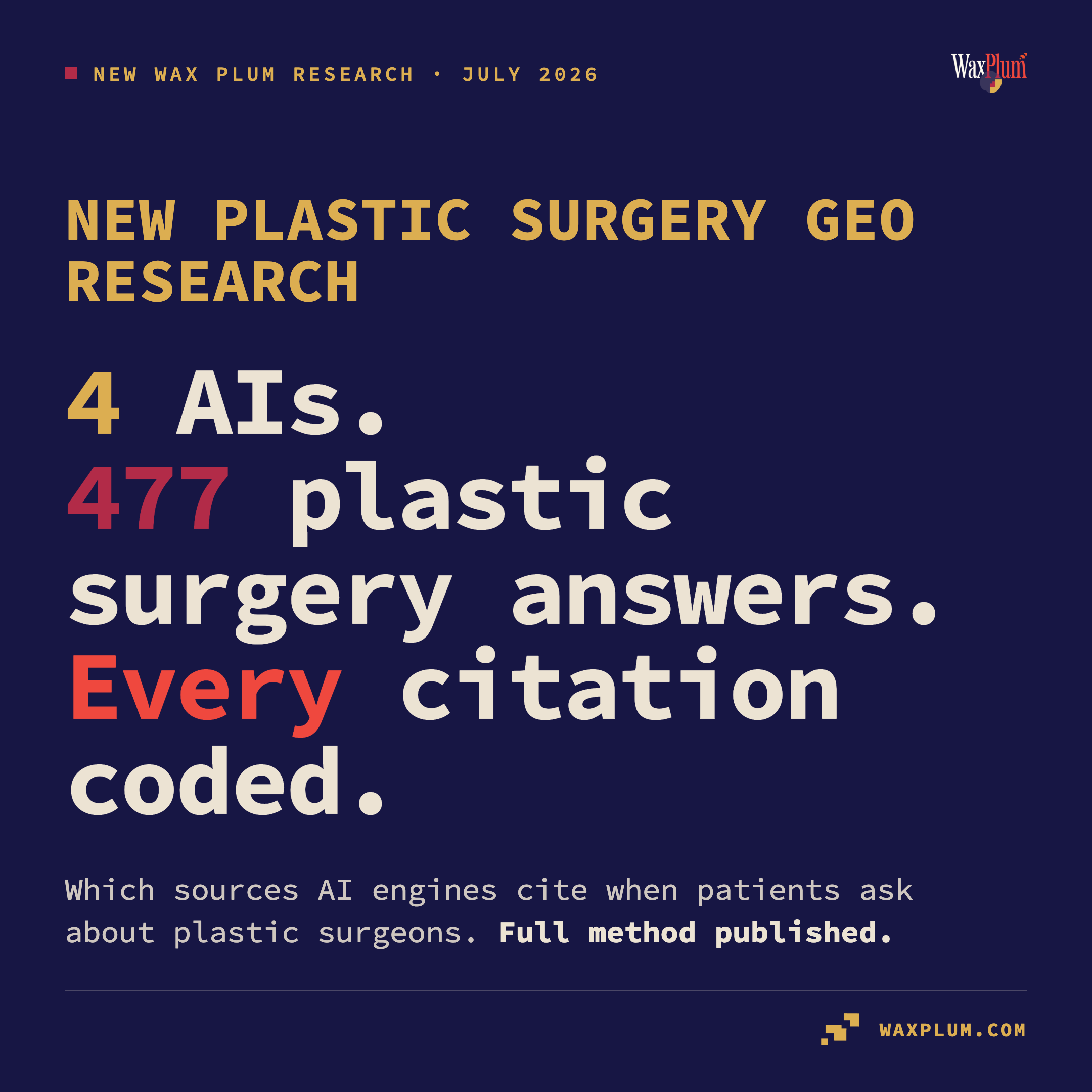
A dated citation snapshot: 477 answers from four AI engines across four metros, July 23, 2026. Which sources each engine pulls from, and what a practice can do about it.
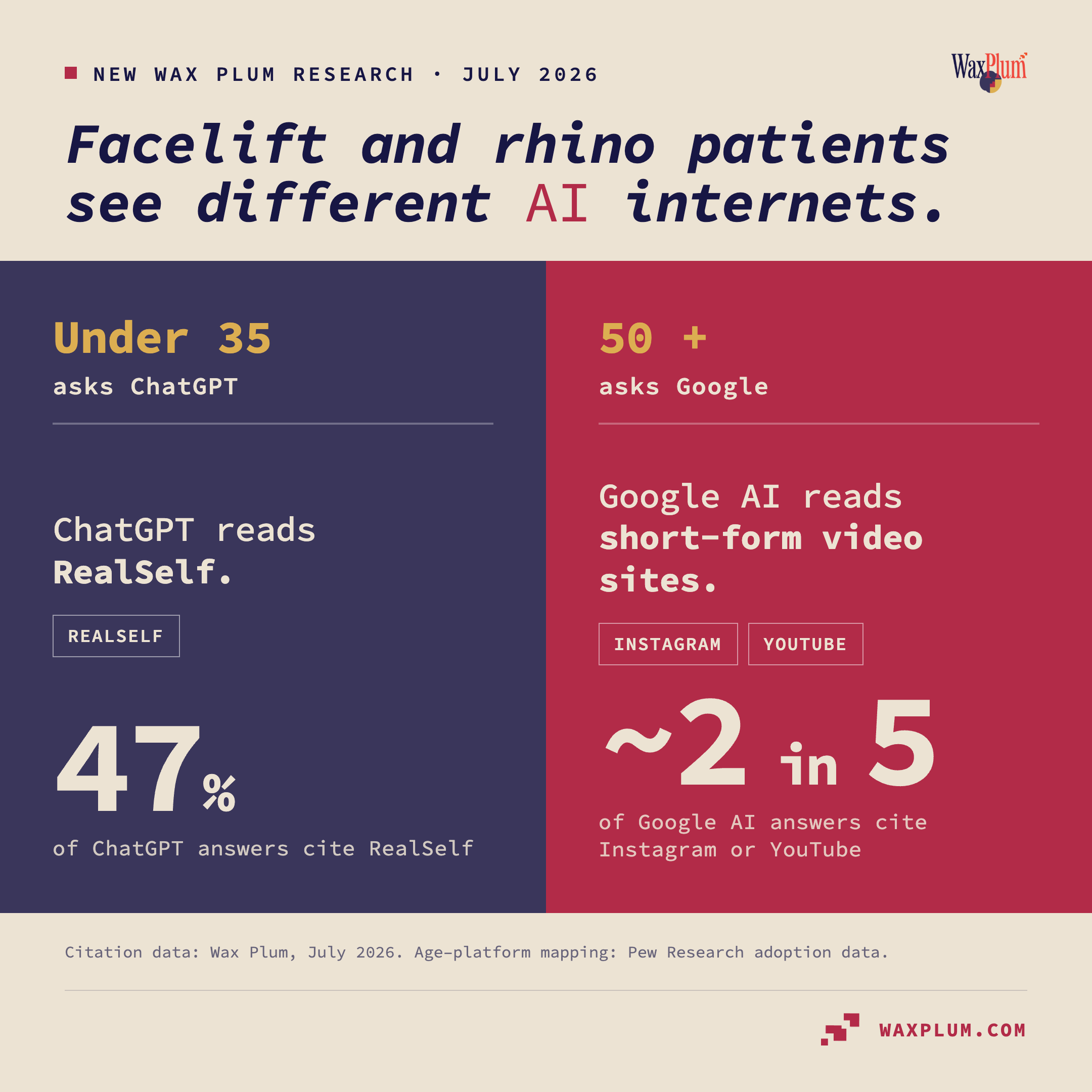
- 01 Nearly 2 in 5 Google AI Overviews answers cite Instagram or YouTube.
- 02 47% of ChatGPT's plastic surgery answers cite RealSelf.
- 03 28% cite Reddit. ChatGPT cited YouTube, Instagram, and TikTok zero times in 120 answers.
- 04 Google's AI answers reputation questions from Google Business Profile reviews.
- 05 The video Google's AI cites answers decision questions, not tutorials.
When a patient asks an AI assistant about a facelift or a rhinoplasty, the answer arrives with sources. We wanted to know whose. So we ran the same panel of patient questions through four AI engines on one day, twice, in four metros, and counted which sources each engine cites.
Google’s AI runs on video, social, and Google
Nearly 2 in 5 AI Overviews answers cited Instagram or YouTube (38%; AI Mode is the same at 37%). RealSelf still appears, about 1 answer in 6, but it competes with social feeds, Yelp, and Google’s own properties. The same questions that produce a RealSelf-and-Reddit answer in ChatGPT produce a video-and-reviews answer in Google.
ChatGPT runs on RealSelf and Reddit
47% of ChatGPT’s answers cited RealSelf at least once, more than any other source a practice can act on. Reddit came second at 28%, then the boards and directories behind them: plasticsurgery.org, ABFPRS, Healthgrades. When a patient asks ChatGPT about a procedure or a surgeon, a large share of what comes back is assembled from your RealSelf profile, Reddit threads, and board listings. If your RealSelf profile is stale, that is your first impression.
What kind of video gets cited
The prompts that pulled YouTube citations were not tutorials. They were decision questions: what a facelift costs, how to choose a surgeon at 55, whether anyone has had a bad facelift in Beverly Hills, credential checks. Patient-decision content, not procedure explainers, is what Google’s AI surfaces reach for video to answer. If your videos explain procedures instead of helping people decide, they are aimed at the wrong questions.
What posting video does to the surgeon rather than to the source list is a separate question, and we took it up in a later study: AI recommends the surgeons who post video, and it links the ones who rank.
Cost questions get answered from practices’ own cost pages
Across the cost and financing bucket, Google’s AI repeatedly cited individual practices’ own cost guides: pages titled “how much is a facelift in Houston” or “rhinoplasty cost in Chicago.” A structured, metro-specific cost page is directly citable material. This is also where the engines split: both Google surfaces cited dozens of individual practice websites; ChatGPT almost never did, preferring the directory layer. Your own site is a citation surface in Google’s AI. In ChatGPT, your representation is whatever RealSelf and Reddit say it is.
Reputation questions get answered from your Business Profile
In Google’s AI Mode, the domain cited more than any other was Google itself, overwhelmingly links into the review viewer showing Google Business Profile reviews. Local reputation questions resolve inside Google, from your Business Profile, without the patient ever leaving. The takeaway is direct: your Google Business Profile, its reviews, their recency and volume, is source material for AI answers about your reputation. Optimize it like the publication it now is.
Different patients, different engines
Platform adoption data (Pew Research) consistently shows ChatGPT usage skewing under 35, while search remains the default across older cohorts. Layered on the citation data: the younger patient researching rhinoplasty or filler is likelier reading an answer built from RealSelf and Reddit; the older facelift consult is likelier reading one built from Instagram, YouTube, and Business Profile reviews. The age-to-engine mapping comes from adoption data, not from these panels.
What this snapshot is and is not
Everything above describes July 23, 2026, and nothing more. One run per panel; engines refresh what they cite, and measuring that movement is the point of running this as a dated series. Gemini is excluded from the findings: 57% of its answers contained no citations at all, too thin to support claims. Prompt sets are frozen and publish as-is, flaws footnoted: one prompt carries a stale metro reference from an earlier draft, and the two panels’ prompts are parallel but not word-for-word mirrors, so we make no metro-versus-metro claims.
Two 60-prompt panels launched the same day, July 23, 2026. Four metros (Los Angeles, Chicago, Miami, Houston), unbranded questions phrased the way a prospective patient asks, four intent buckets: finding a provider, cost and financing, credential verification, reputation.
ChatGPT, Google AI Overviews, Google AI Mode, Gemini. 477 answers: ChatGPT 120, AI Overviews 117, AI Mode 120, Gemini 120. Claude ran in one panel only and is excluded from combined numbers. Perplexity and Copilot were not measured in this run.
For each engine, we counted which answers cite each domain, using Ahrefs Brand Radar citation data on our custom prompt panels. Domains reported are a fixed list of places a practice could realistically publish to or be listed on. A domain counts once per answer.
The two panels are a same-day replication. Every headline pattern held in both panels, in different metros, independently.
House, G. (2026). Who AI cites when patients ask about plastic surgery: a citation snapshot, July 23, 2026 (v1.0). Wax Plum Research. waxplum.com/research/who-ai-cites-when-patients-ask-about-plastic-surgery
Runs the Wax Plum research lab. Seventeen years in SEO, now studying how AI search decides what to cite. info@waxplum.com