AI recommends the surgeons who post video. It links the ones who rank.
 By Garth House
First-of-its-kind study*: every board-certified facial plastic surgeon in four major metros, tested against four AI engines.
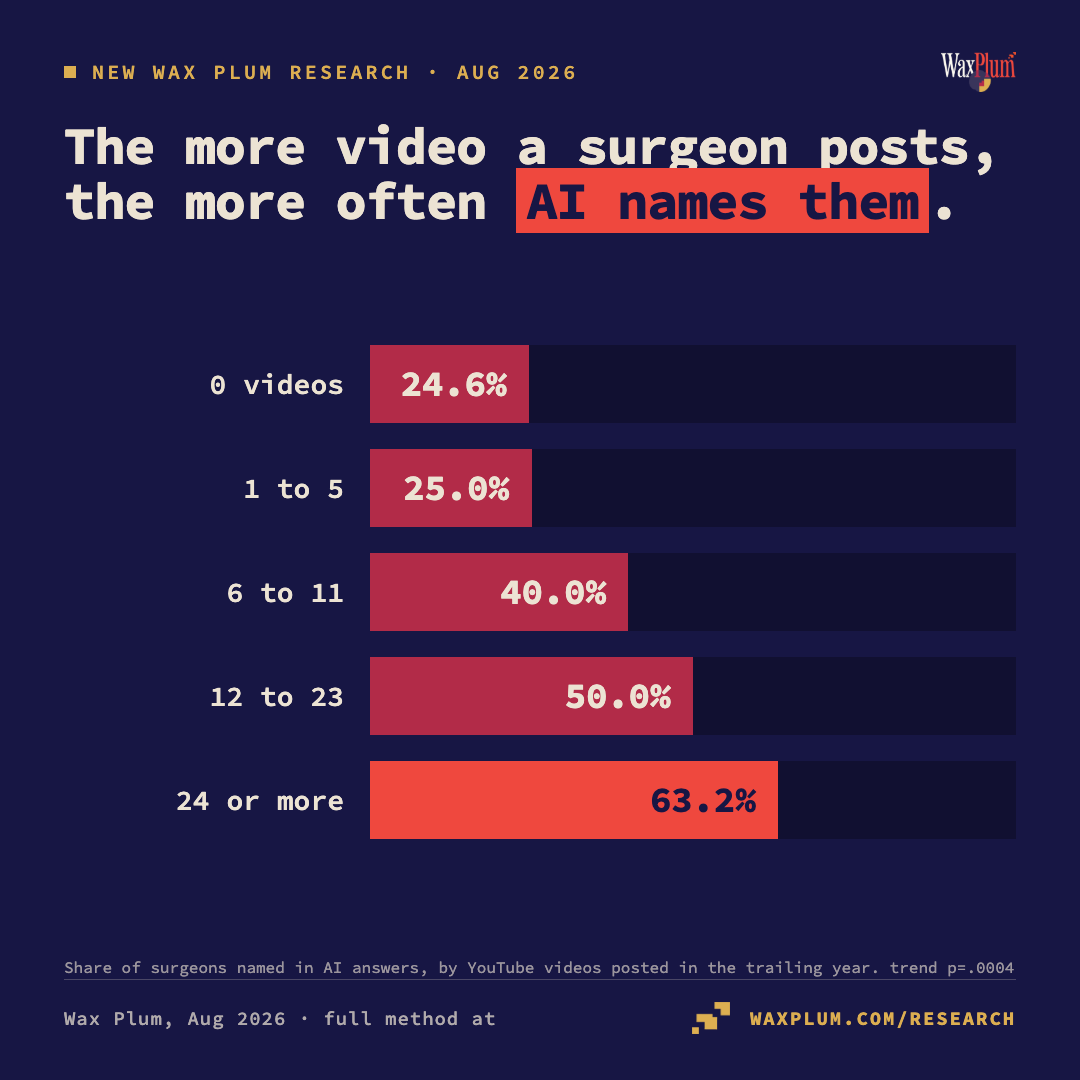
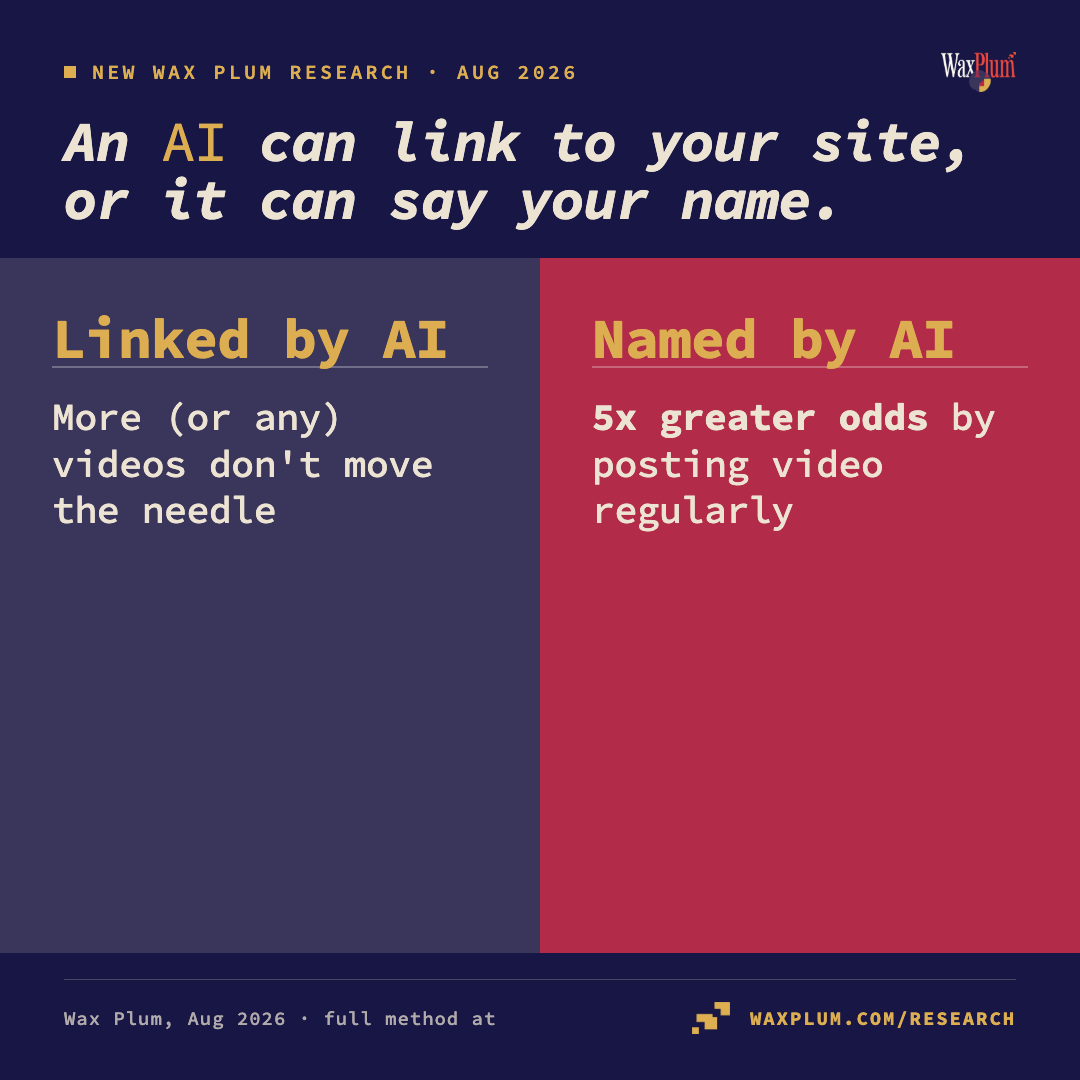
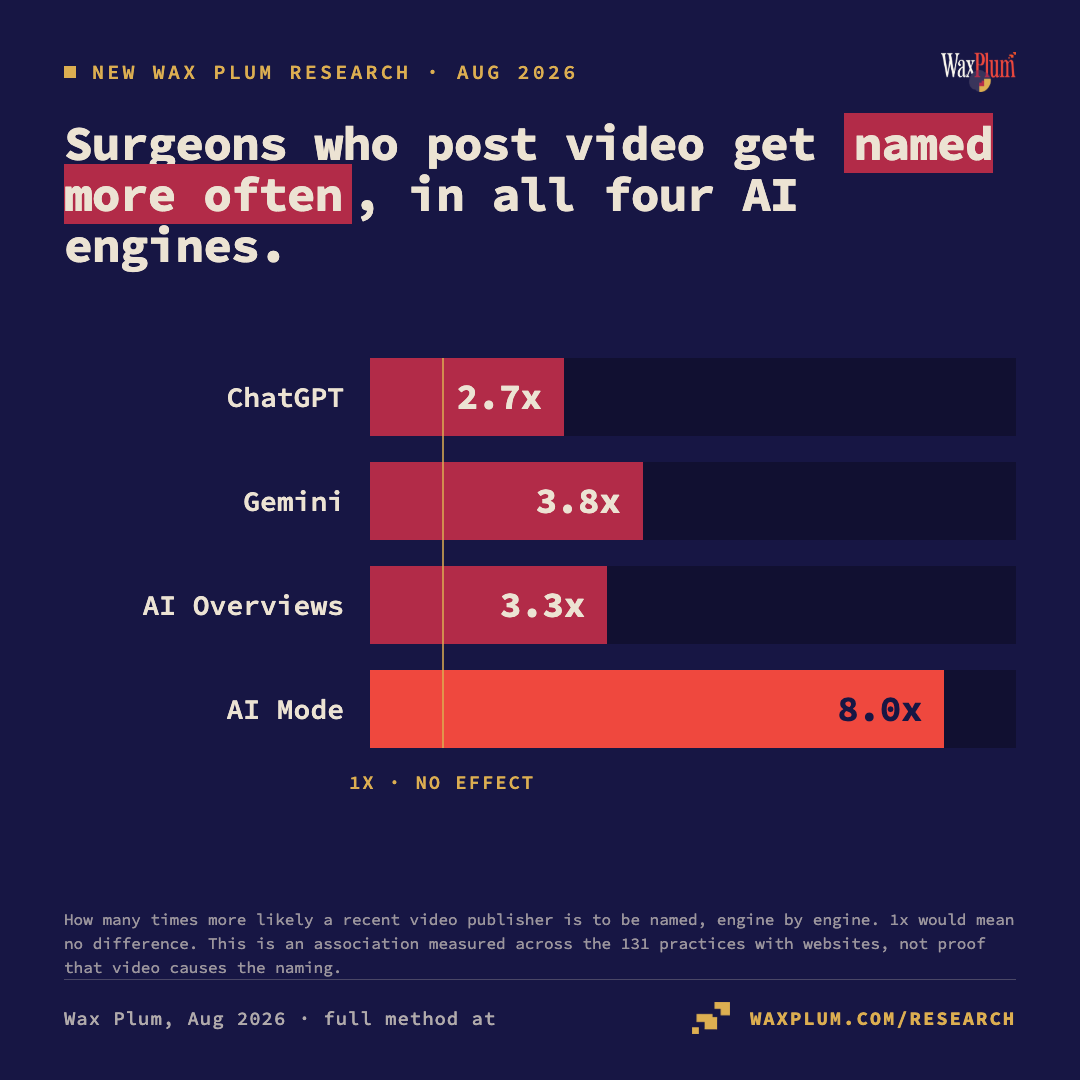
- 01 Practices publishing 12+ YouTube videos a year had about 5x the odds of being named, and 3.9x once search authority is in the model.
- 02 The association ran the same direction on all four engines, analyzed separately.
- 03 Being cited tracks Google search authority, not YouTube publishing.
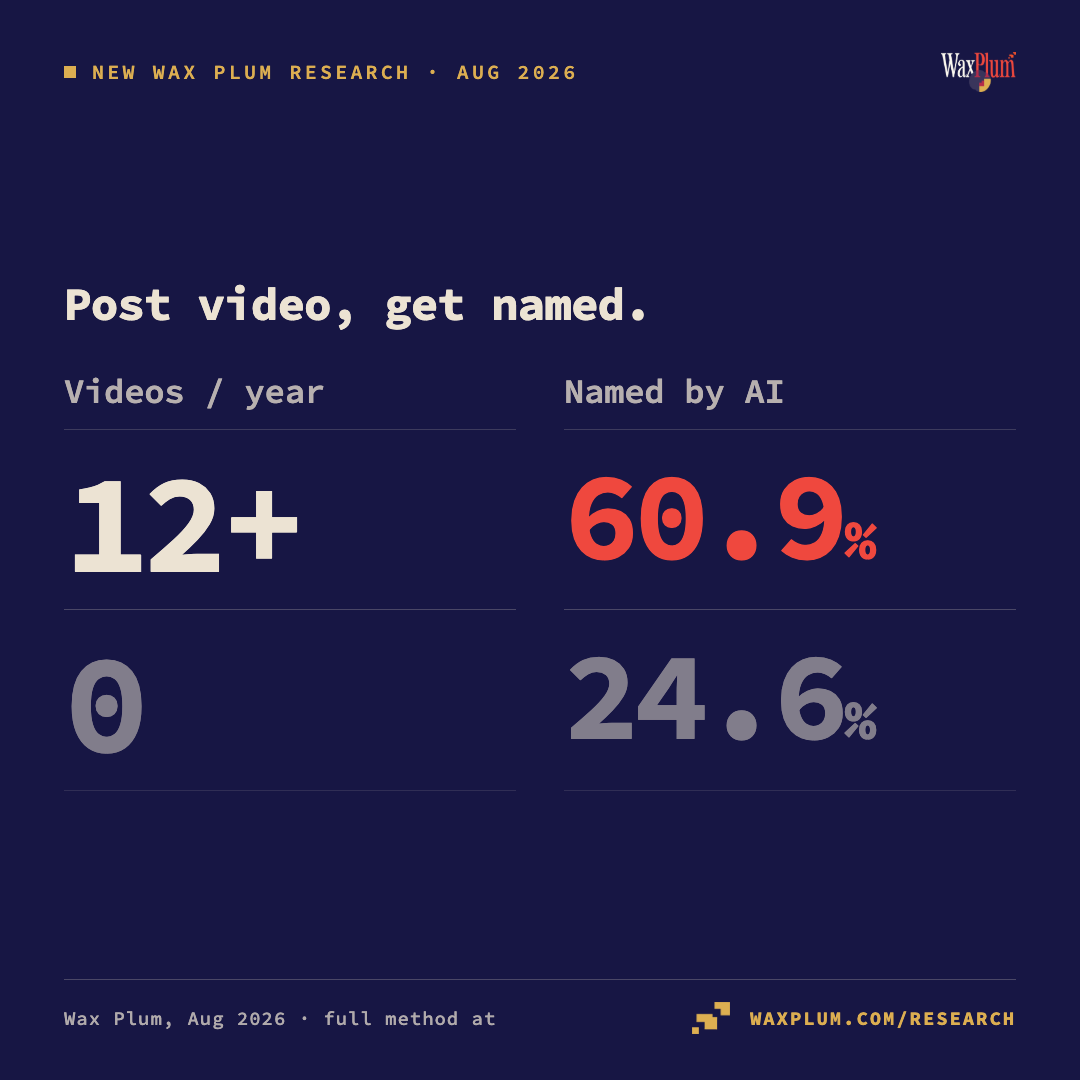
- 04 A staircase: 24.6% named at zero videos, 63.2% at 24 or more.
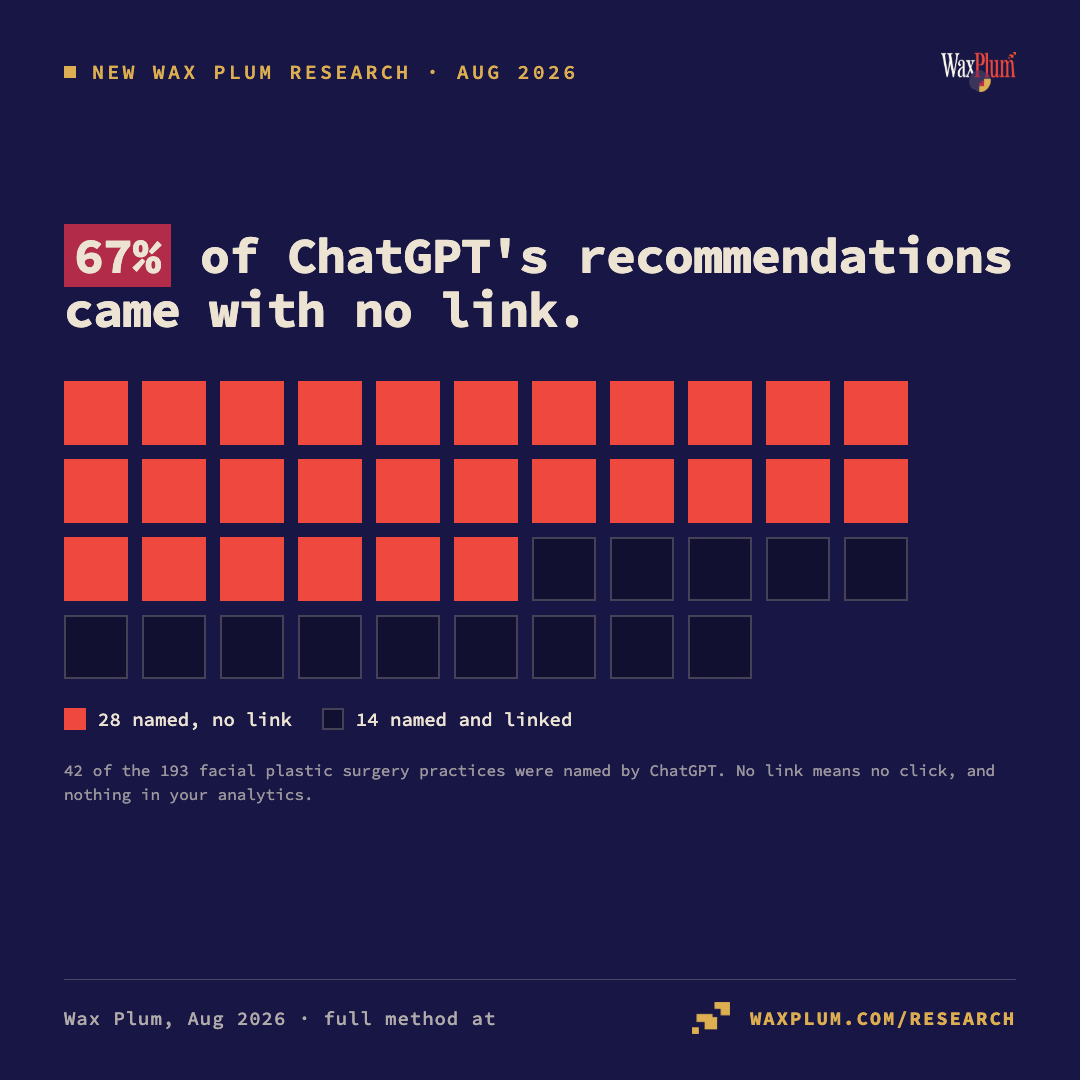
- 05 ChatGPT names practices it never links: 28 of the 42 it named carried no citation.
Being named and being linked are different outcomes
When a patient asks an AI who to see, the answer contains names, and sometimes links. We measured both, separately, for every board-certified facial plastic surgeon in four major metros. They are not the same outcome and they do not have the same cause. Getting your website linked is a Google authority story: the practices already ranking get cited, and YouTube publishing did nothing detectable to change it. Getting your name said is different: recent YouTube publishing goes with it strongly, about five times the odds across the full frame of 170 practices, adjusted for employment model and metro. Among the 131 practices where we could also adjust for search authority, it is just under four times. The association ran the same direction on all four engines, analyzed separately.
The step from nothing to a handful of videos is not really a step: 24.6% against 25.0%. The climb starts at six videos a year and keeps going. Splitting the top bucket does not hold up, and we are not going to pretend otherwise: 24 to 47 videos ran 71% and 48-plus ran 58%, which inverts the order, on cells of 7 and 12 practices. Two practices flip it. We report 24+ merged and make no saturation claim.
Citations are a different game
Whether an engine links a practice’s website tracks how that practice already ranks in Google. Organic search authority was associated with being cited in three of the four engines, and was directionally positive in the fourth. YouTube publishing added nothing detectable to citations on any engine: not presence, not volume. The one exception is narrow: on Google AI Mode alone, recent publishing was also associated with being cited. That is a single-engine observation and we state it as one. Everywhere else, the citation door opens with the same key it always has: ranking.
The engines don’t behave alike
ChatGPT named 42 practices in our answers. Of those, 14 were also cited and 28 carried no citation at all. ChatGPT cited 29 practices in total, so most of what it links is not what it names. Google AI Overviews and AI Mode run the other way: they cite more practices than they name. The practical consequence: any tool that measures AI visibility by citations alone is measuring the Google-shaped half of the picture and missing two-thirds of the practices ChatGPT named.
A unit note for careful readers: Semrush’s ghost-citations work reports ChatGPT as citation-heavy (87% cited vs 21% mentioned) at the level of domain appearances; we measure at the level of practices. Both are true. A handful of directory domains absorb most of ChatGPT’s links while the practices it recommends go unlinked. Our earlier study, who AI cites when patients ask about plastic surgery, counts which domains those are.
What this extends
This extends two literatures. The first is vendor research on what correlates with AI visibility, all of it at brand or domain level. Ahrefs measured 75,000 brands, a set filtered to larger domains, and found YouTube mentions the strongest correlate of AI visibility they tested (Spearman roughly 0.737); we take the question to the individual practice and find it survives authority adjustment. Semrush and Kevin Indig’s ghost-citations study separated mentions from citations at the level of domain appearances; we replicate the split at the practitioner level and show the two outcomes go with different things: recency with being named, authority with being cited. Halcy and Nathan Woo audited a random sample of 200 independent practices against ChatGPT at the organization level, with no video measure, and found none of the 200 named or cited.
The second is the peer-reviewed physician-recommendation audit literature, which already establishes that AI engines will recommend real, named clinicians and that the recommendations shift with how the question is asked. Parikh and colleagues (2024) asked ChatGPT, Bing and Bard to recommend oculoplastic surgeons across the twenty largest US cities and evaluated the 672 suggestions that came back. A 2026 study in the International Journal of Medical Informatics ran 40,500 ChatGPT queries about real orthopedic surgeons while varying patient characteristics, and found the model would not name anyone in 52.8% of responses. Neither measures a video exposure, neither separates being named from being cited at the level of the practitioner, and neither works from a census frame. What they give us is the prior that this behavior is real and measurable in named clinicians, which is the ground this study builds on.
That last result and ours look like they disagree, so we will say it before a reviewer does. None of 200 against 56 of the 170 we analyzed is a counterpoint, not a contradiction. They sampled practice organizations at random and read one engine; we ran a census of named individuals across four. Unit, frame, and engine coverage account for the gap. Worth saying too that the Ahrefs and Semrush figures are vendor research rather than peer review, and correlational by their own authors’ account. We treat them as directional.
To our knowledge, as of August 2026, this is the first study to use YouTube publishing recency as the exposure for an individual’s AI visibility, the first mention and citation split at practitioner level, the first census frame in this literature, and the first to show the two outcomes have different association patterns. We did not run a formal test of dissociation, so that last one is a description of what the models show, not a statistical claim about the difference between them. Everything else here is replication or extension.
What this is not
This is observational and cross-sectional. One specialty, four cities, one snapshot. The exposure was measured after the answers were captured, so the ordering does no causal work for us, and nothing here says posting caused anything. The obvious confound is real and we name it plainly: practices that publish on YouTube likely market harder in ways we cannot adjust for, we have no measure of marketing spend or agency representation, and our authority control is a proxy rather than a guarantee. Instagram was not measured at all, so every claim on this page is about YouTube publishing and nothing else. The name matcher was tuned against false positives, so if anything we undercount mentions. The causal test is a before and after publishing ramp; we are running it on our own brand and will publish the result either way. Our data also contained errors we caught ourselves: the full defect log and the blind-repair record are in the companion method note.
What a practice does with this
Post video on a schedule; what moves with being named is recent publishing, not having published once. Keep doing the site work, because your Google authority still decides whether you get linked. But know which prize is which: patients hear names.
Wax Plum runs this system for a number of practices: the surgeon on camera, on a schedule, published where the engines read. No booking funnel and no sales call. If you think your practice fits, send a plain note to study@waxplum.com and tell us what you do.
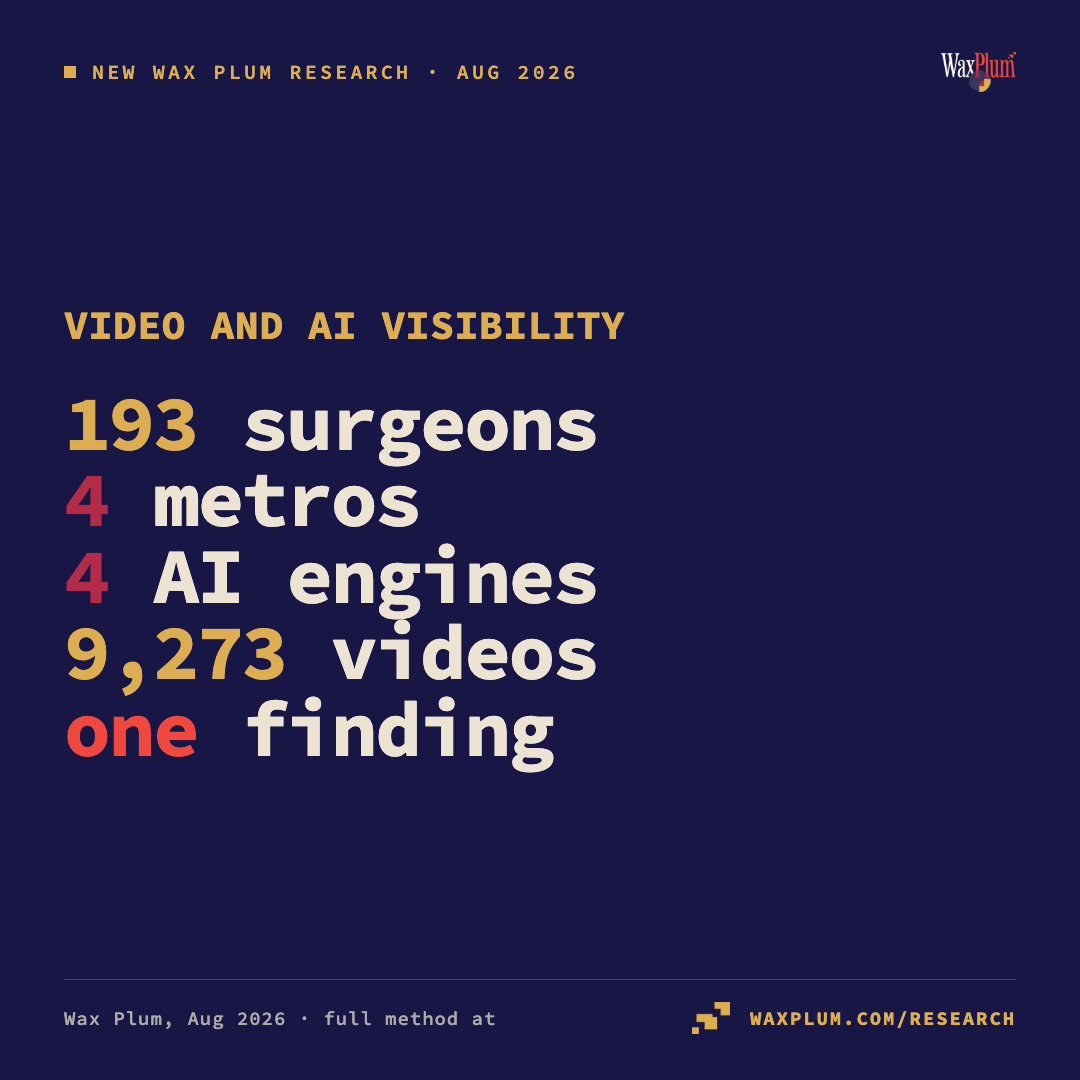
Census frame: every ABFPRS-certified facial plastic surgeon with a practice in Los Angeles, Chicago, Miami, or Houston. 193 practices in the roster (LA 97, Chicago 39, Miami 21, Houston 36); 170 analyzed after excluding 2 identity-error rows and 21 rows whose video counts were nulled. Nobody entered the study by being visible anywhere.
YouTube publishing per practice, measured as uploads in the trailing 12 months: 131 channels resolved, 104 practices publishing at least once, 9,273 videos captured. Nulled rows are excluded, never counted as zero. Instagram was not measured, so every claim here is about YouTube publishing only.
Two, per engine: NAMED (surgeon or practice named in the answer text) and CITED (practice domain in the sources), mined from 480 answers to patient-shaped questions across ChatGPT, Google AI Overviews, Google AI Mode, and Gemini. Two Brand Radar panels, 60 prompts, four engines, July 23, 2026.
Logistic regression. The full frame (170) adjusts for employment model and metro; the adjusted subset (131) also adjusts for organic search authority; it is complete-case on the authority covariate and a usable video measurement, which excludes 17 practices with websites whose video counts were nulled. Sensitivity: dropping the 26 unknown-employment rows leaves the estimate at 4.87 on the full frame and 3.82 on the adjusted subset.
The initial data carried identity errors. 16 namesake YouTube channels nulled, 5 institutional or shared channels excluded, 15 domains corrected, 7 removed as dead or not the practice's, 4 nulled on failed hand verification, 36 websites recovered. All repairs were made blind to the outcome columns, with the prediction registered beforehand that cleanup would strengthen the estimate. It did. The full defect log publishes in the companion method note.
* On “first of its kind”
We ran a prior-art sweep from 2024 to August 2026 across vendor research, GEO practitioners, and the peer-reviewed literature before publishing this. We found no study, report, or preprint that names individual plastic surgeons across a metro census and measures their AI visibility, and none that uses video publishing as the exposure for any individual person. The nearest work is Halcy and Nathan Woo’s random sample of 200 practice organizations against a single engine, in which plastic surgery is one of eighteen specialties. A universal negative cannot be proven, so read the claim as “to our knowledge, as of August 2026.” If earlier work surfaces, we will say so here and date the correction.
House, G. (2026). AI recommends the surgeons who post video, it links the ones who rank: YouTube publishing and AI visibility in a census study of 193 facial plastic surgery practices (v1.0). Wax Plum Research. waxplum.com/research/ai-recommends-the-surgeons-who-post
Runs the Wax Plum research lab. Seventeen years in SEO, now studying how AI search decides what to cite. info@waxplum.com